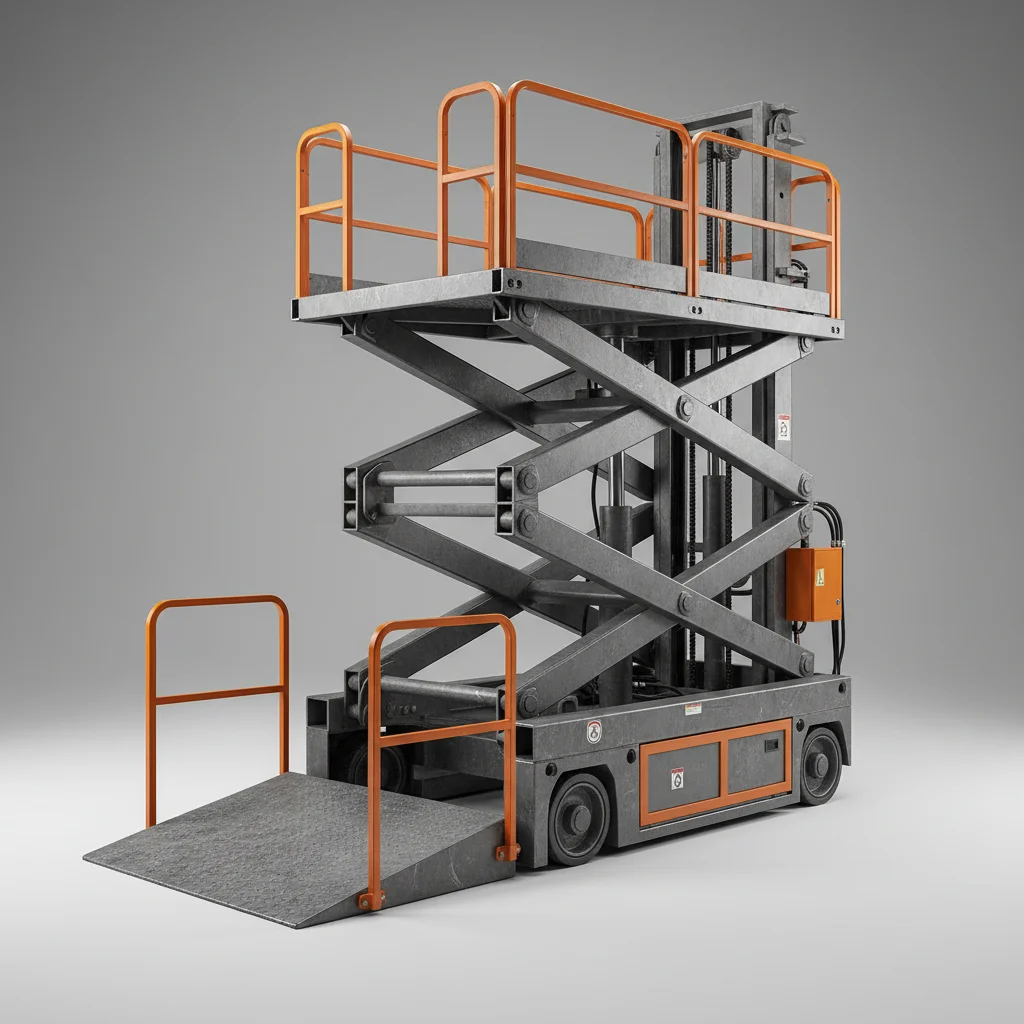
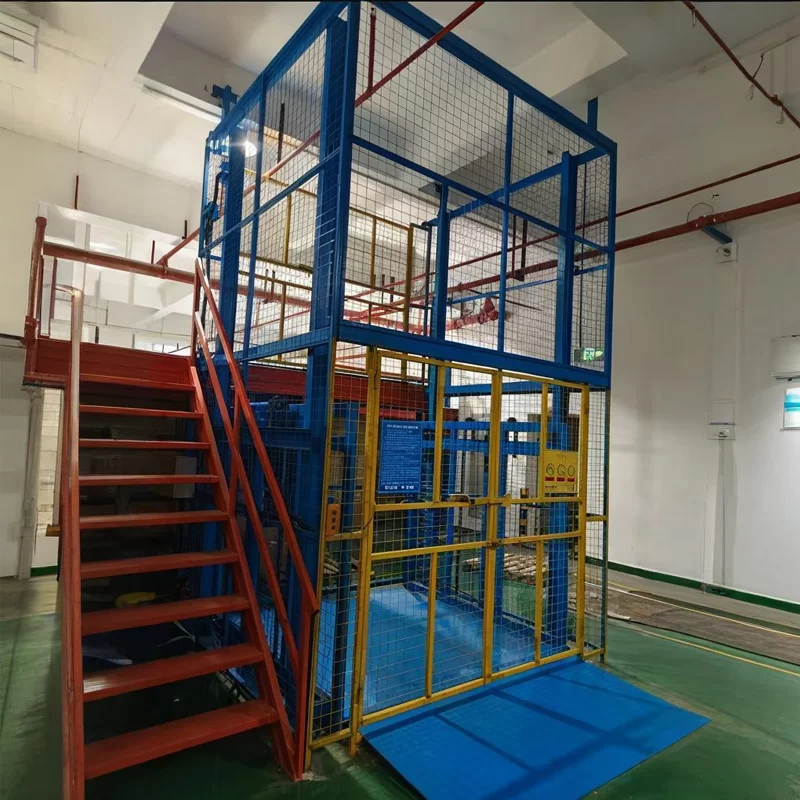
Indoor Hydraulic Freight Lift System Composition
The indoor hydraulic freight lift consists of three core systems:
1. Mechanical Structure
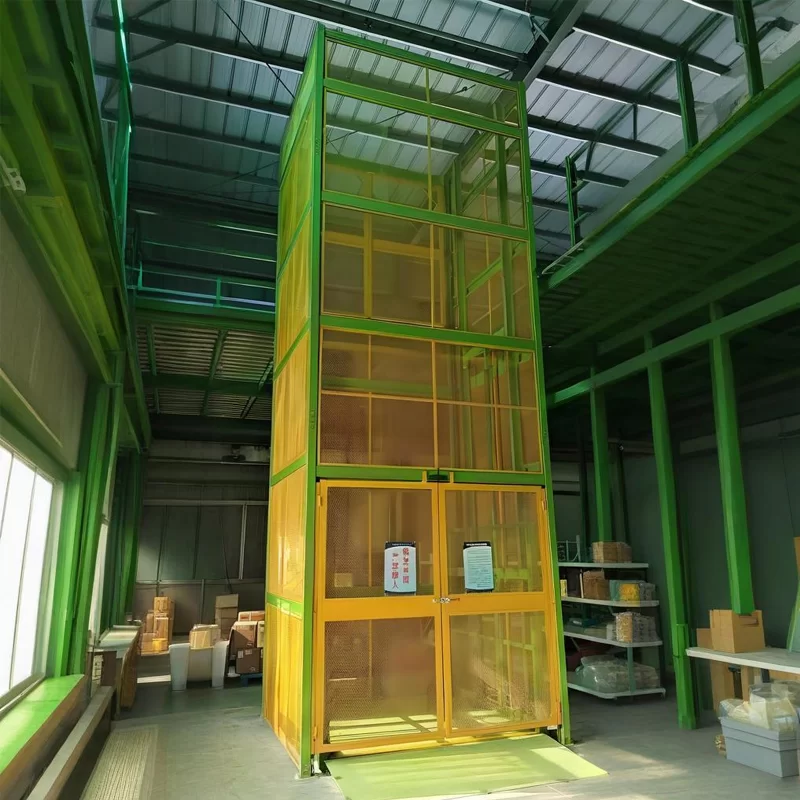
The mechanical structure includes the guide rails, carriage, loading platform, and safety enclosures.
Guide Rail System: Heavy-duty steel guide rails are mounted securely to the building structure or independent steel frames, providing precise vertical guidance for the carriage.
Carriage: The carriage adopts an enclosed elevator style box design constructed from high strength steel. It is equipped with multiple guide wheels (typically 8–24 depending on model) that run along the rails, ensuring stable, balanced lifting even under uneven load distribution.
Doors and Enclosures: Available with manual or automatic sliding doors, swing doors, or folding gates. Full height enclosures or interlocked safety gates at each landing prevent accidental access during operation.
2. Hydraulic System
The hydraulic system comprises a power unit, hydraulic cylinders, and control valves.
Power Unit: A compact pump station with an electric motor drives the hydraulic pump. The unit can be installed remotely (up to 10–15 meters from the lift) to minimize noise at the loading point.
Hydraulic Cylinder: One or multiple direct acting or indirect acting cylinders provide lifting force. The cylinder is equipped with a guide mechanism at the top to ensure vertical extension and reduce seal wear.
Valve System: Integrated solenoid valves, flow control valves, and anti burst valves enable precise speed regulation and safety lock-off in the event of hydraulic line failure.
3. Electrical System
The electrical system manages motor start/stop, valve actuation, and safety interlocks.
Control Panel: PLC or relay based control with an intuitive operator interface. All control circuits operate at a safe low voltage (≤24V).
Call Stations: Push button call stations are installed at each floor level, typically with position indicators and audible alerts.
Safety Interlocks: Interlocks ensure that the lift cannot operate unless all landing doors or gates are properly closed. Limit switches at the upper and lower travel stops prevent over travel.
Indoor Hydraulic Freight Lift Key Features and Performance Advantages
Space-Saving Design: Requires minimal pit depth (as low as 100 mm) and no overhead machine room, making it ideal for low headroom buildings or retrofit projects.
High Load Capacity: Available in capacities ranging from 500 kg to 10,000 kg or more, accommodating pallet trucks, hand carts, and large-volume shipments.
Smooth and Stable Operation: Hydraulic drive provides inherently smooth acceleration and deceleration. The multi-point guide wheel system distributes the load evenly, preventing tilting and reducing stress on the hydraulic cylinder.
Enhanced Safety Features:
Hydraulic Burst Valve: Automatically locks the cylinder in place if hydraulic pressure is lost.
Overload Protection: Prevents operation when the rated load is exceeded.
Emergency Lowering: Manual lowering valve allows safe descent during power outages.
Interlocked Landing Doors: Prevents access to the lift shaft while the carriage is not at the landing.
Durable Construction: The carriage and guide rails are constructed from heavy gauge steel with corrosion resistant coatings, ensuring long service life in demanding industrial environments.
Energy Efficiency: Compared to traction elevators with counterweights, hydraulic lifts consume energy only during the lifting cycle; lowering is accomplished by gravity with minimal energy input.
Easy Maintenance: The power unit is typically located outside the shaft or at ground level, allowing easy access for servicing without entering the lift shaft.
Indoor Hydraulic Freight Lift Application Scenarios
Multi-Story Factories: Transporting raw materials, work in process, and finished goods between production floors.
Warehouses and Distribution Centers: Moving palletized loads, heavy containers, and bulk materials between mezzanines and ground levels.
Commercial Buildings: Stock replenishment between retail floors, restaurant supplies from basement storage to kitchen levels.
Hotels and Hospitality: Linen, food, and equipment transport between service floors without using guest elevators.
Institutional Facilities: Hospitals, schools, and libraries moving supplies, furniture, or equipment between floors.
Indoor Hydraulic Freight Lift Technical Specifications (Typical)
Parameter
Range
Load Capacity
500 kg – 10,000 kg
Lifting Height
Up to 20 m
Pit Depth
100 mm – 300 mm (optional zero pit with ramp)
Overhead Requirement
None (no machine room required)
Platform Size
Customizable to fit pallet or load dimensions
Lifting Speed
4 – 8 m/min (standard, adjustable)
Control Voltage
≤24V (safe low voltage)
Door Options
Manual sliding, automatic sliding, swing, folding gate
Specifications vary by model and configuration.
- Summary
The Indoor Hydraulic Freight Lift combines robust construction, hydraulic reliability, and space efficient design to deliver a superior solution for vertical goods transport in indoor environments. Its low pit requirement, absence of an overhead machine room, high load capacity, and comprehensive safety features make it the preferred choice for facilities seeking a cost effective, durable, and easy to install alternative to conventional freight elevators.
Whether for new construction or retrofitting into existing buildings, this system provides dependable, efficient material handling that supports uninterrupted daily operations.
-
Request a Quote for Hydraulic Logistics Equipment
Tell us your requirements and get a fast, customized solution for lift tables, dock levelers, and other hydraulic logistics equipment.