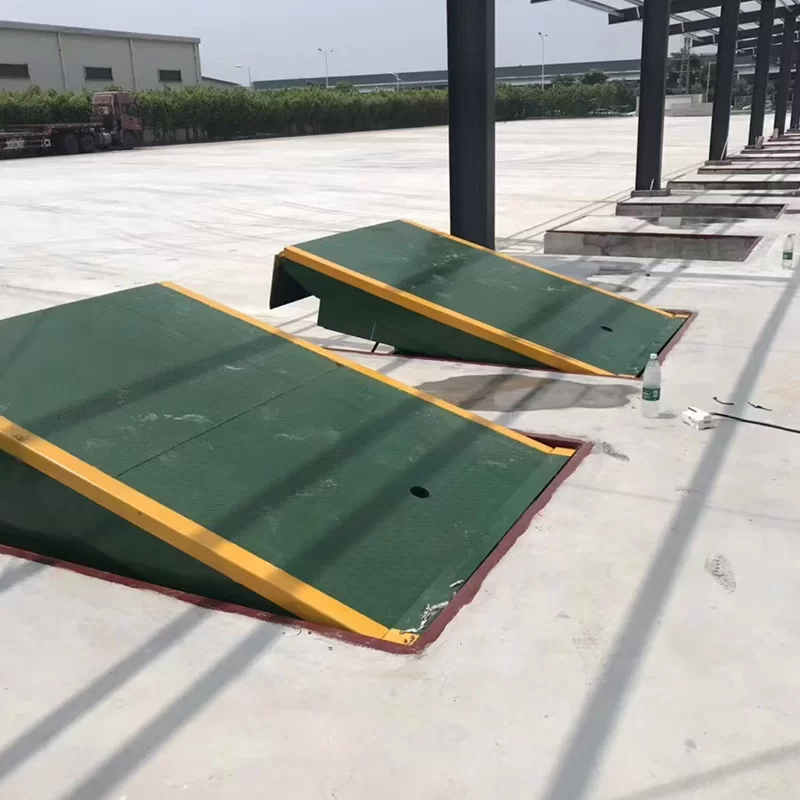
Container Loading Dock Leveler System Composition
The container loading dock leveler consists of the following core components:
1. Main Platform and Lip
Main Platform: Made of high-strength anti-slip steel plate, it bears the full weight of forklifts and cargo. The surface features anti-slip tread patterns or mesh grating to ensure traction in rainy, snowy, or oily conditions.
Lip: Located at the front of the platform, the lip extends and lowers to rest on the edge of the vehicle bed, bridging the gap between the dock and the vehicle to ensure smooth passage for forklift tires.
2. Hydraulic / Power System
Hydraulic Power Unit: Consists of a motor, hydraulic pump, reservoir, and control valves to drive platform lifting/lowering and lip extension/retraction.
Mechanical Spring System (for mechanical models): Utilizes high-durability balance springs to enable light manual operation without electrical power.
Pneumatic / Electric Systems (optional): Available for explosion-proof environments or special requirements.
3. Control and Safety Devices
Control System: Available as push-button stations, pull-cord switches, or inductive controls, mounted on the dock sidewall for convenient operation.
Safety Support Bar: Used to mechanically lock the platform during maintenance or cleaning to prevent accidental descent.
Bumper: Installed at the dock face to reduce impact from vehicles backing into the building or equipment.
Anti-slip Edges and Warning Markings: Clearly define the work area boundary to improve operational safety.
Container Loading Dock Leveler Main Features and Performance Advantages
High Load Capacity
Dynamic load ratings range from 6 tons to 15 tons, with heavy-duty models exceeding 20 tons, accommodating various forklifts and heavy cargo.
Smooth Transition Design
The platform and lip are connected by a hinged structure. As the vehicle bed rises or falls due to load changes during loading/unloading, the lip maintains continuous contact with the bed, ensuring smooth forklift passage without bumps.
Fast Response and High Efficiency
Hydraulic models complete raising, extending, and lowering cycles within 10–15 seconds, significantly reducing preparation time. Mechanical models allow single-person operation with balance springs, requiring no external power.
Multi-Environment Adaptability
Optional stainless steel or hot-dip galvanized finishes suitable for food processing, cold chain, and outdoor environments.
Low-temperature hydraulic oil and heating elements available to ensure reliable startup in cold climates.
Dust-sealed construction reduces ingress of debris, extending service life.
Safe and Reliable
Built-in burst valves in the hydraulic system prevent sudden platform descent in the event of hose failure.
Anti-slip steel plate surface prevents forklift tire slippage.
Side safety guards prevent personnel from falling into the gap between the dock and the vehicle.
Container Loading Dock Leveler Type Selection
Type
Drive Method
Application Scenarios
Hydraulic
Electro-hydraulic
High-frequency operation, heavy loads, automated control requirements
Mechanical
Balance spring + manual
Sites without power supply, low-frequency use, budget-constrained
Air Bag
Inflatable air bag
Clean environments, applications sensitive to hydraulic oil
Telescopic
Hydraulic / Electric
Situations with significant vehicle parking deviation, need for extended reach
Container Loading Dock Leveler Application Scenarios
Distribution Centers: High-frequency loading/unloading with dozens to hundreds of vehicles per day, improving turnaround efficiency.
Manufacturing Warehouses: Standardized docks for raw material receiving and finished goods shipping.
Cold Chain Logistics: Used in conjunction with insulated seals to minimize cold loss during loading/unloading.
E-commerce Warehousing: Supporting rapid loading/unloading across diverse vehicle types and high volumes.
Postal / Parcel Sorting Centers: Integrated with telescopic belt conveyors for efficient parcel handling.
Container Loading Dock Leveler Installation and Maintenance
Installation: The leveler is embedded into the dock foundation and secured to the concrete structure using cast-in-place anchor bolts or chemical anchors to ensure rigidity. Standard dock height is typically 1.2–1.3 meters, matching the bed height of most containers and trucks.
Maintenance: Regularly inspect hydraulic oil levels, lubricate hinge points, clean anti-slip surfaces, and verify the safety support bar function. Professional maintenance every 3–6 months is recommended.
- Summary
The container loading dock leveler is an essential piece of equipment for achieving standardized, efficient, and safe loading dock operations. Whether for high-frequency distribution centers or manufacturing facilities with stringent stability requirements, selecting the appropriate dock leveler can significantly reduce vehicle turnaround time, lower operator fatigue, and protect both forklifts and cargo. With its robust construction, flexible configurations, and comprehensive safety features, the dock leveler has become an indispensable component of modern warehousing facilities.
- What Is a Container Loading Ramp Platform
A container loading ramp platform provides a controlled transition between a warehouse floor and a shipping container vehicle, allowing forklifts and pallet jacks to move cargo into and out of containers. The Container Loading Platform on the supplied product page is designed as a fixed hydraulic loading solution for logistics parks, manufacturing plants, cross-border e-commerce warehouses, cold-chain logistics facilities, and other industrial loading environments. Rather than relying on a simple inclined surface, the platform uses hydraulic lifting to adjust its working position according to the height of the vehicle.
The main platform is manufactured from high-strength steel plates or non-slip checkered plates and welded into a rigid structure. The front lip extends toward the rear edge of the container vehicle and rests on the vehicle floor to create the loading transition. The base frame is fabricated from rectangular tubes or I-beams and is fixed to the pit or ground. This configuration gives the container loading ramp a permanent position within the loading area and provides a stable foundation for repeated forklift traffic.
The supplied product information specifies a typical lifting range of +300 mm to –300 mm, with the possibility of expanding the range according to the selected configuration. This allows the platform to compensate for differences between container trucks and vans instead of requiring every vehicle to arrive at exactly the same loading height. The rated load range is 6–15 tons, with heavy-duty configurations available up to 20 tons. The actual capacity and dimensions should be confirmed according to the selected model, forklift load, vehicle dimensions, and site requirements.
The platform operates through an electro-hydraulic system consisting of an electric hydraulic pump station, lifting cylinders, lip cylinders, and control valves. The lifting cylinders raise and lower the main platform, while the lip cylinders independently control the front lip. This arrangement allows the hydraulic ramp function to be integrated directly into the loading platform rather than relying on manual repositioning of a separate ramp.
The deck uses a high-friction checkered plate to provide traction for material-handling equipment. Reflective warning strips, rubber bumpers, safety catches, hydraulic protection, and electrical travel-limit controls are also incorporated or available according to the configuration. The combination of these components makes the system suitable for repeated container loading operations where the loading interface needs to remain integrated with the facility.
For procurement teams, the important distinction is that this is not simply a steel access ramp. The container loading ramp platform combines a structural deck, hydraulic lifting mechanism, adjustable front lip, electrical control system, and safety devices into one fixed loading unit.
Electro-Hydraulic Power & Lifting System for Shipping Container RampThe electro-hydraulic system controls the primary lifting function of the Container Loading Platform and allows the equipment to adapt to different container vehicle heights. The system consists of an electric hydraulic pump station, lifting cylinders, lip cylinders, and hydraulic control valves. This arrangement allows the main platform and front lip to move independently while remaining part of the same loading system.
The main lifting cylinders control vertical platform movement. The typical lifting range is +300 mm to –300 mm, with the possibility of expansion according to the selected configuration. This range allows the platform to compensate for differences in vehicle height. For a shipping container ramp, this hydraulic adjustment is important because container trucks and vans may not have identical deck heights.
The front lip has its own hydraulic cylinders and can extend toward the vehicle after the platform reaches the required position. The lip rests on the rear edge of the container vehicle and provides the transition required for forklift and pallet-jack access. Its curved or serrated tip is designed to improve contact with the vehicle.
The rated load range is 6–15 tons, with heavy-duty configurations available up to 20 tons. The structure uses high-strength steel plates or checkered plates, while the base frame uses rectangular tubes or I-beams. Synchronized dual cylinders support the lifting movement, and flow-control valves help regulate hydraulic operation.
Hydraulic protection is incorporated into the system through anti-burst valves and overload protection. If the working load exceeds the intended rating, the overload protection is designed to prevent the hydraulic system from continuing to lift the excessive load. Emergency lowering through the release valve provides a manual recovery method if electrical power is interrupted or a hydraulic problem occurs.
When comparing this equipment with a shipping container ramp based only on a passive inclined structure, the hydraulic platform provides an additional adjustment function. The main deck can change position according to the vehicle height, while the front lip separately establishes the vehicle connection.
The platform is intended for fixed installation into a pit or onto the ground. This makes it suitable for facilities with established container loading bays where repeated forklift traffic takes place at the same general loading location. The electro-hydraulic system becomes part of the site's permanent loading infrastructure rather than a separate mobile unit.
For facilities considering a mobile dock leveler, the main selection question is whether the loading point needs permanent hydraulic integration or equipment that can be repositioned. The Container Loading Platform is designed around the former arrangement, combining lifting, lip adjustment, electrical control, and safety protection into one fixed loading interface.
- Integrated Safety Devices for Dock Leveler for ISO Shipping Container
The safety configuration of the Container Loading Platform combines mechanical retention, hydraulic protection, electrical controls, traction surfaces, and auxiliary devices. This is important because the platform is designed for forklift and pallet-jack traffic, meaning the loading interface must remain controlled while heavy equipment crosses between the warehouse and container.
A mechanical or hydraulic safety catch is installed at the front of the platform. The supplied product information states that this device is intended to prevent the platform from dropping if the vehicle unexpectedly moves away. This safety function works together with the hydraulic system rather than depending on hydraulic pressure alone.
The hydraulic circuit includes anti-burst valves, flow-control valves, and overload protection. These components regulate hydraulic movement and provide protection within the lifting circuit. Synchronized dual cylinders are used to support stable lifting and lowering of the main platform.
The deck is manufactured with a high-friction checkered surface to improve traction. Reflective warning strips and impact-absorbing rubber bumpers can be incorporated around the platform edges. These auxiliary devices provide additional visibility and help reduce the effects of contact around the loading area.
Electrical controls provide another layer of protection. The system includes upper and lower travel-limit switches and a limit switch for the front-lip extension. Push-button or remote-control operation is available, while safety interlocks help control the operating sequence. The control voltage is typically no more than 24V.
Emergency lowering is also part of the design. In the event of power failure or hydraulic malfunction, the platform can be lowered manually through the release valve. This provides a defined recovery method without requiring normal electrical operation.
For procurement teams evaluating a dock leveler for iso shipping container, the safety system should be assessed together with load capacity and lifting range. The platform is available in rated loads from 6 to 15 tons, with heavy-duty configurations up to 20 tons, while the typical lifting range is +300 mm to –300 mm. The selected specification should match the actual forklift, cargo, vehicle, and installation conditions.
Optional vehicle restraint devices, warning lights, and voice prompts can also be incorporated according to project requirements. The hydraulic system is described as water- and dust-resistant, while corrosion-resistant treatment is available for demanding operating environments.
For a dock leveler for iso shipping container, these safety components form part of the complete equipment configuration. The mechanical structure, hydraulic circuit, electrical controls, front lip, and auxiliary devices need to work together to provide a controlled container loading interface.
- Maintenance Checklist for a Hydraulic Ramp
Maintenance of the Container Loading Platform is mainly concerned with the hydraulic system, structural components, front lip, electrical controls, and safety devices. The product information identifies hydraulic oil inspection and lubrication of pivot points as routine maintenance requirements. Because the platform combines several operating systems, regular checks should cover both the lifting mechanism and the loading interface.
The hydraulic system includes an electric hydraulic pump station, lift cylinders, lip cylinders, and control valve groups. The lift cylinders control the main platform, while the lip cylinders control front-lip movement. Anti-burst valves, flow-control valves, and overload protection are incorporated into the hydraulic circuit. These components work together to control platform movement and protect the hydraulic system.
Hydraulic oil levels should be checked according to the maintenance schedule. Visible leakage, irregular platform movement, unusually slow lifting, or abnormal hydraulic behavior should be investigated before continued operation. The pump station is modular, which supports access for inspection and servicing.
The pivot points should also receive the required lubrication. These points support movement between the platform structure and front lip, so their condition directly affects mechanical operation. Operators should also inspect the front lip to ensure that it extends and retracts correctly and that the contact surface remains suitable for vehicle connection.
The structural components deserve routine visual inspection as well. The main deck uses high-strength steel plates or checkered plates, while the base frame uses rectangular tubes or I-beams. Welded connections, visible structural members, the platform surface, and the front lip should be checked for obvious deformation or damage, particularly in facilities where forklifts operate frequently.
The electrical controls are another part of the maintenance scope. The platform uses a control box, operation panel, limit switches, and safety interlocks. The limit switches control upper and lower platform travel and the front-lip extension position. The control voltage is typically no more than 24V. During routine inspection, the operator should confirm that the control functions and travel limits respond as intended.
The safety catch should also be checked because it provides protection against platform drop if the vehicle unexpectedly moves away. Emergency lowering is available through manual operation of the release valve if electrical power is lost or a hydraulic malfunction occurs.
For facilities evaluating ahydraulic ramp, maintenance should therefore cover the complete operating chain rather than focusing only on hydraulic oil. Hydraulic components, moving connections, steel structure, electrical controls, front lip, and safety mechanisms all contribute to reliable loading performance.
- Container Loading Platform VS Mobile Yard Ramp
A fixed Container Loading Platform and a mobile yard ramp can both provide forklift access between ground level and shipping containers, but they are intended for different site arrangements. The Container Loading Platform is fixed to a pit or ground structure, while a mobile yard ramp is designed to be repositioned when the loading location changes.
For facilities with established container loading bays, the fixed platform becomes part of the permanent infrastructure. The base frame remains installed at the selected loading position, while the electro-hydraulic system adjusts the platform height. The front lip extends toward the container vehicle and rests on the rear edge, creating the transition required for forklifts and pallet jacks.
A mobile yard ramp takes a different approach. Its main value is the ability to move between loading points. This can be useful for temporary sites, shared loading areas, or yards where container positions change regularly. Instead of permanently assigning equipment to one bay, the ramp can be brought to the active loading location.
The Container Loading Platform is more closely integrated with the building or loading area. Its typical lifting range of +300 mm to –300 mm allows it to adapt to different vehicle heights. The platform is rated for 6–15 tons, with heavy-duty configurations up to 20 tons, making the system suitable for substantial forklift and pallet-truck loading requirements.
The hydraulic adjustment is also an important difference. A mobile ramp normally provides a predetermined inclined route, while the Container Loading Platform can raise or lower its main deck before the front lip is positioned against the vehicle. This gives the fixed system greater control over the interface between the warehouse and vehicle. For a facility handling containers from a dedicated loading position every day, the fixed arrangement can provide a consistent operating interface. A mobile yard ramp becomes more relevant when loading locations change or permanent construction is not practical.
The selection should therefore start with the site layout rather than the equipment name. If the loading point is permanent and the facility needs hydraulic height adjustment, the Container Loading Platform is designed for that operating model. If mobility between several loading positions is the priority, a mobile configuration may be the more appropriate direction.
-
Request a Quote for Hydraulic Logistics Equipment
Tell us your requirements and get a fast, customized solution for lift tables, dock levelers, and other hydraulic logistics equipment.