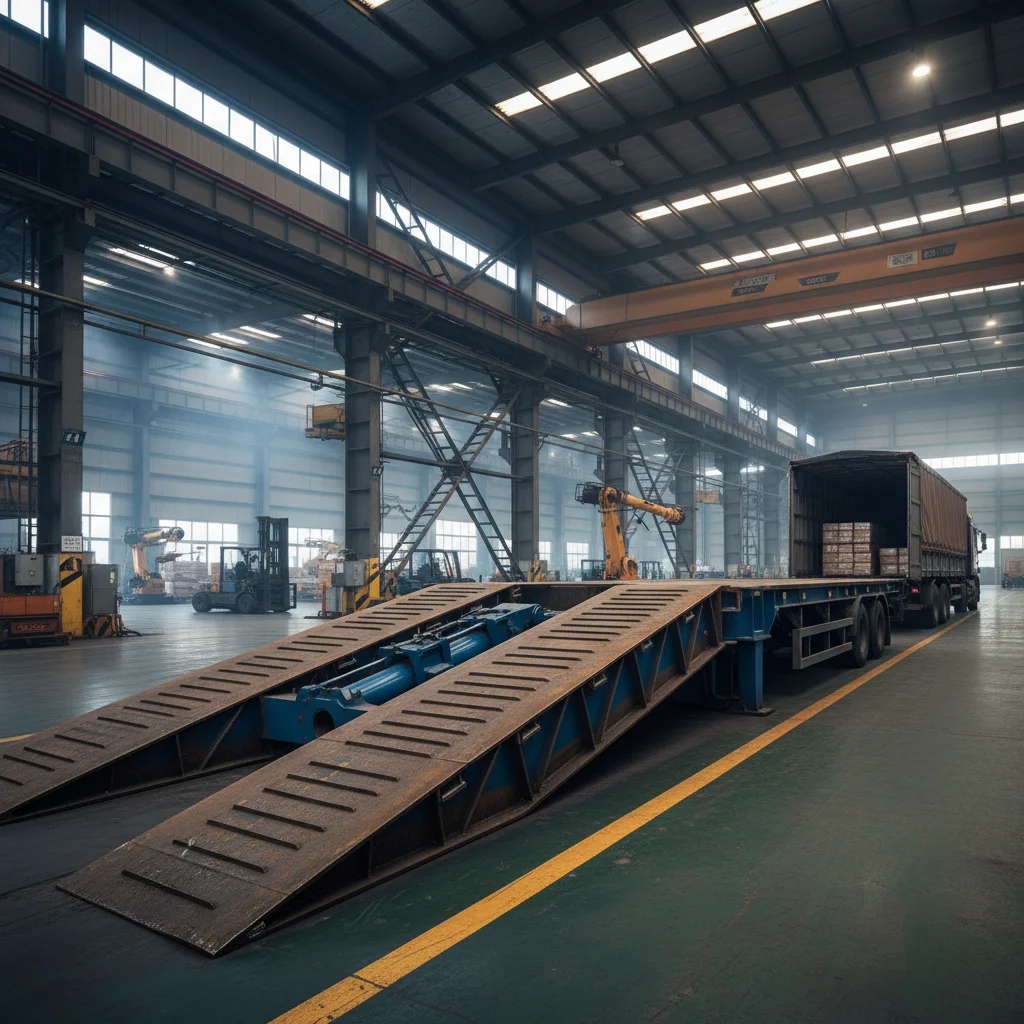
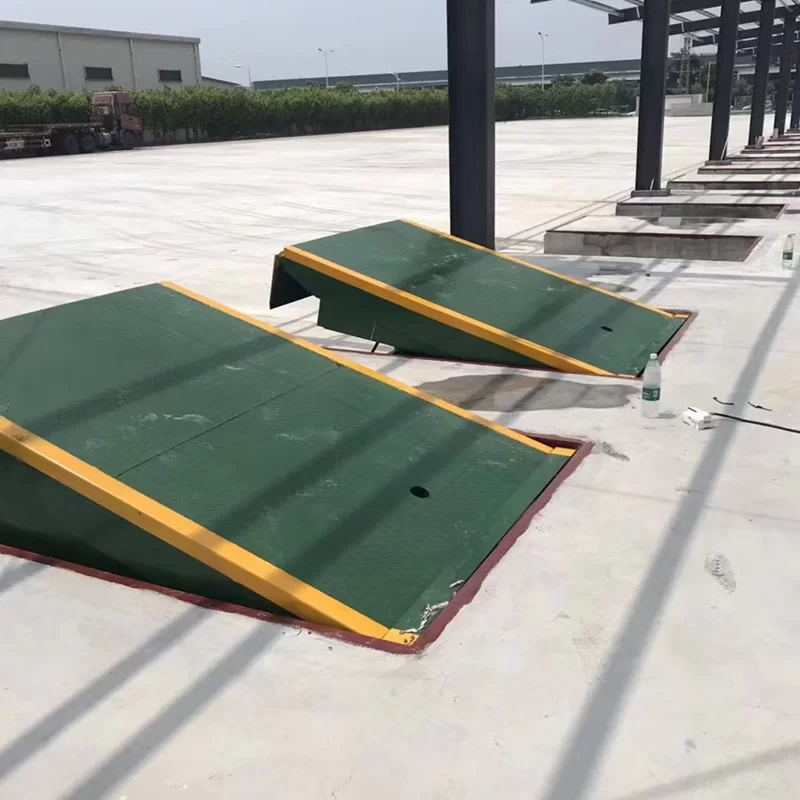
Container Loading Dock Leveler System Composition
The container loading dock leveler consists of the following core components:
1. Main Platform and Lip
Main Platform: Made of high-strength anti-slip steel plate, it bears the full weight of forklifts and cargo. The surface features anti-slip tread patterns or mesh grating to ensure traction in rainy, snowy, or oily conditions.
Lip: Located at the front of the platform, the lip extends and lowers to rest on the edge of the vehicle bed, bridging the gap between the dock and the vehicle to ensure smooth passage for forklift tires.
2. Hydraulic / Power System
Hydraulic Power Unit: Consists of a motor, hydraulic pump, reservoir, and control valves to drive platform lifting/lowering and lip extension/retraction.
Mechanical Spring System (for mechanical models): Utilizes high-durability balance springs to enable light manual operation without electrical power.
Pneumatic / Electric Systems (optional): Available for explosion-proof environments or special requirements.
3. Control and Safety Devices
Control System: Available as push-button stations, pull-cord switches, or inductive controls, mounted on the dock sidewall for convenient operation.
Safety Support Bar: Used to mechanically lock the platform during maintenance or cleaning to prevent accidental descent.
Bumper: Installed at the dock face to reduce impact from vehicles backing into the building or equipment.
Anti-slip Edges and Warning Markings: Clearly define the work area boundary to improve operational safety.
Container Loading Dock Leveler Main Features and Performance Advantages
High Load Capacity
Dynamic load ratings range from 6 tons to 15 tons, with heavy-duty models exceeding 20 tons, accommodating various forklifts and heavy cargo.
Smooth Transition Design
The platform and lip are connected by a hinged structure. As the vehicle bed rises or falls due to load changes during loading/unloading, the lip maintains continuous contact with the bed, ensuring smooth forklift passage without bumps.
Fast Response and High Efficiency
Hydraulic models complete raising, extending, and lowering cycles within 10–15 seconds, significantly reducing preparation time. Mechanical models allow single-person operation with balance springs, requiring no external power.
Multi-Environment Adaptability
Optional stainless steel or hot-dip galvanized finishes suitable for food processing, cold chain, and outdoor environments.
Low-temperature hydraulic oil and heating elements available to ensure reliable startup in cold climates.
Dust-sealed construction reduces ingress of debris, extending service life.
Safe and Reliable
Built-in burst valves in the hydraulic system prevent sudden platform descent in the event of hose failure.
Anti-slip steel plate surface prevents forklift tire slippage.
Side safety guards prevent personnel from falling into the gap between the dock and the vehicle.
Container Loading Dock Leveler Type Selection
Type
Drive Method
Application Scenarios
Hydraulic
Electro-hydraulic
High-frequency operation, heavy loads, automated control requirements
Mechanical
Balance spring + manual
Sites without power supply, low-frequency use, budget-constrained
Air Bag
Inflatable air bag
Clean environments, applications sensitive to hydraulic oil
Telescopic
Hydraulic / Electric
Situations with significant vehicle parking deviation, need for extended reach
Container Loading Dock Leveler Application Scenarios
Distribution Centers: High-frequency loading/unloading with dozens to hundreds of vehicles per day, improving turnaround efficiency.
Manufacturing Warehouses: Standardized docks for raw material receiving and finished goods shipping.
Cold Chain Logistics: Used in conjunction with insulated seals to minimize cold loss during loading/unloading.
E-commerce Warehousing: Supporting rapid loading/unloading across diverse vehicle types and high volumes.
Postal / Parcel Sorting Centers: Integrated with telescopic belt conveyors for efficient parcel handling.
Container Loading Dock Leveler Installation and Maintenance
Installation: The leveler is embedded into the dock foundation and secured to the concrete structure using cast-in-place anchor bolts or chemical anchors to ensure rigidity. Standard dock height is typically 1.2–1.3 meters, matching the bed height of most containers and trucks.
Maintenance: Regularly inspect hydraulic oil levels, lubricate hinge points, clean anti-slip surfaces, and verify the safety support bar function. Professional maintenance every 3–6 months is recommended.
- Summary
The container loading dock leveler is an essential piece of equipment for achieving standardized, efficient, and safe loading dock operations. Whether for high-frequency distribution centers or manufacturing facilities with stringent stability requirements, selecting the appropriate dock leveler can significantly reduce vehicle turnaround time, lower operator fatigue, and protect both forklifts and cargo. With its robust construction, flexible configurations, and comprehensive safety features, the dock leveler has become an indispensable component of modern warehousing facilities.
-
Request a Quote for Hydraulic Logistics Equipment
Tell us your requirements and get a fast, customized solution for lift tables, dock levelers, and other hydraulic logistics equipment.